
Nexthink competitors don’t always get the credit they deserve. Often, they’re better-fitting alternatives for organizations that never quite matched Nexthink's measurements in the first place.
Nexthink is an excellent product, but it’s sometimes not the right cut for organizations that operate at mid-market scale, move fast, and need their digital employee experience (DEX) platform to keep pace.
If your business is one of them, you have seen this friction show up in:
- A gap between Nexthink’s analysis and action, which still requires IT resources to close
- A vendor relationship that moves at enterprise pace, with roadmap changes that reflect global priorities, not yours
- An architecture designed for the world's largest organizations, in markets that operate very differently from your own.
If this is the case, then a better alternative may be closer than you think.
Read on to learn more about five excellent Nexthink competitors based on their digital employee experience management – and why they could be a better fit for your organization.
- Why Nexthink may not be the best fit for IT teams in 2026
- What to look for in a Nexthink alternative
- The DEX shortlist: 5 Nexthink competitors that make the cut
- Flexxible: The Nexthink alternative trusted by leaders like you
Looking for the best Nexthink alternative? Book a demo with Flexxible to find out how you can measure business performance across a diverse remote workforce.
Why Nexthink may not be the best fit for IT teams in 2026
Take a look at Gartner's list of recommended DEX tools, and Nexthink sits at the top of the chart, and for good reason.
Its platform offers excellent data analysis, world-class dashboards and deep analytical functions built for enterprise-scale operations, yet there’s a growing gap between what the architecture was designed for and the needs of mid-market and European organizations.
“Nexthink is a visually impressive, data-rich platform, but it's built for analysis, not action,” says Federico Zani, Technical Evangelist at Flexxible.

This gap becomes clear when it comes to moving from insight to resolution. There’s no native remote support capability, so when issues occur, IT teams are kept at arm’s length from end users. There’s no way for them to remotely execute fixes directly on the device without escalation.
Nexthink’s architecture is also monolithic, which keeps customers locked into what exists today without a meaningful roadmap for changes. “It's best suited for very large enterprises whose complexity justifies a primarily analytical approach,” continues Federico.
For IT leaders in faster-moving mid-market organizations, it simply wasn't built with their pace, scale, or priorities in mind.
Many are now exploring which other DEX platforms for enterprises are out there.
What to look for in a Nexthink alternative
The DEX management tools market has a growing number of solutions that market themselves as Nexthink alternatives, but not all of them are worthy of the tag.
As an IT leader, putting together a checklist like the one below will lead you to the options that go beyond digital experience monitoring to deliver genuine operational value.
1. Does it offer real-time remediation across your entire hybrid estate?
Detecting IT issues should be a given for modern tools. The best options quickly move from this observability to automated self-healing workflows – across VDI, DaaS, and remote environments – without requiring your IT team to intervene or switch consoles.
2. Does it have ITSM integration that fits your existing workflows?
If you run ServiceNow or a similar platform, your DEX tool should integrate seamlessly with it rather than run alongside it.
3. Does it offer transparent pricing and flexible onboarding?
Platforms that require full enterprise commitment before they demonstrate value should be avoided. The best Nexthink alternatives will let you start with core use cases and scale up. Prices should also be clear from the outset.
4. Are they quick and easily accessible?
This may be harder to gauge, but online reviews will give you an insight. In fast-moving IT environments, platforms must respond quickly and respond to customer feedback, or they'll become just another source of digital friction rather than a solution to it.
5. Is it trusted by your peers?
Only one group of people know what it’s like to manage a complex enterprise IT environment at scale – other IT leaders. Peer review platforms like Gartner and G2 will tell you more about the day-to-day reality than any product brochure will.
The DEX shortlist: 5 Nexthink alternatives that you should consider
1. Flexxible (FlexxClient) — The leading European alternative
Flexxible is the most strategically relevant Nexthink alternative in the market for organizations operating across hybrid European estates.
Its core platform, FlexxClient, is an SaaS DEX management platform hosted on Microsoft Azure that spans more than 600,000 endpoints in enterprise and mid-market organizations. Like Nexthink, it has also been recognised in the 2025 Gartner Magic Quadrant, but comes with several crucial benefits.
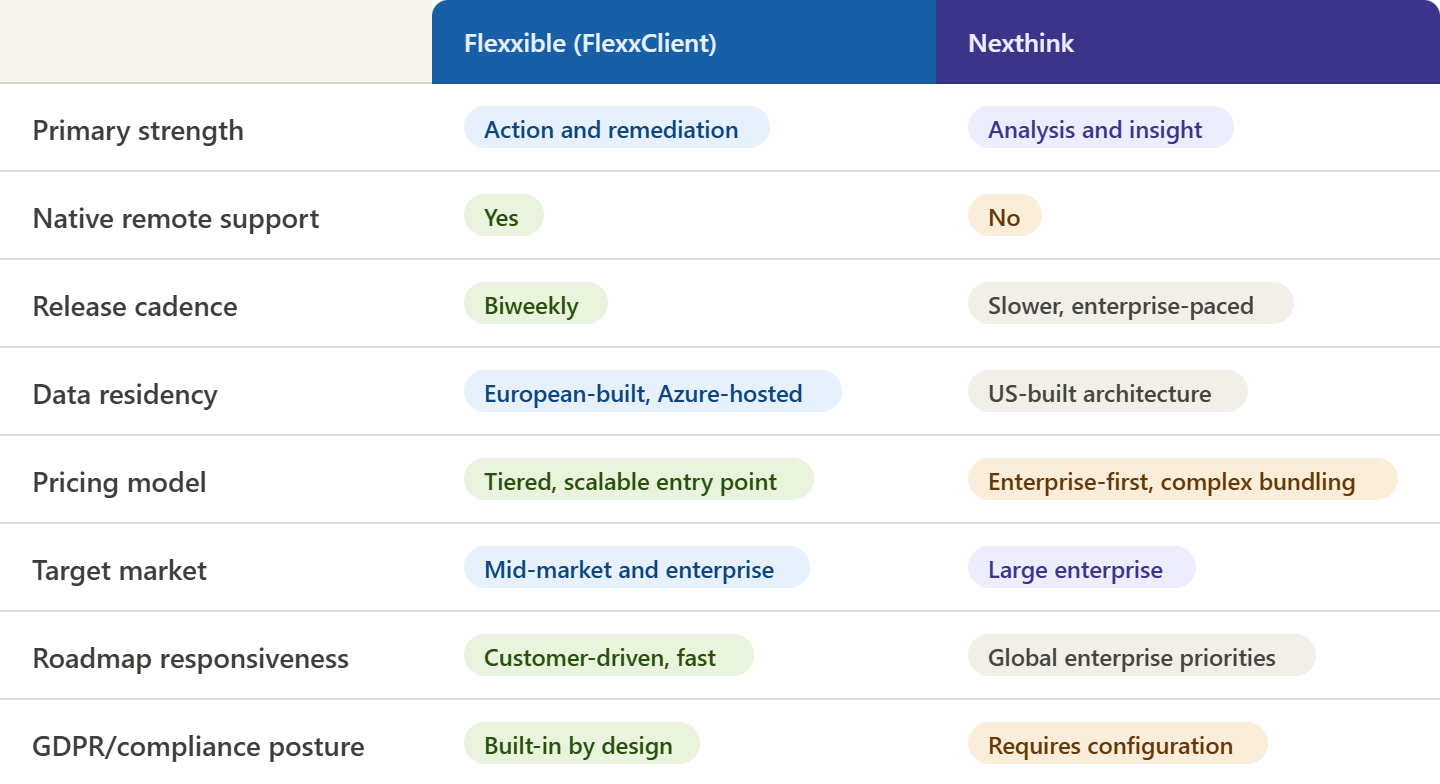
First, the platform eradicates the distance between detection and action, with real-time endpoint monitoring, self-healing automation, and native remote assistance packed in a single console. Fast-moving IT teams quickly notice the results.
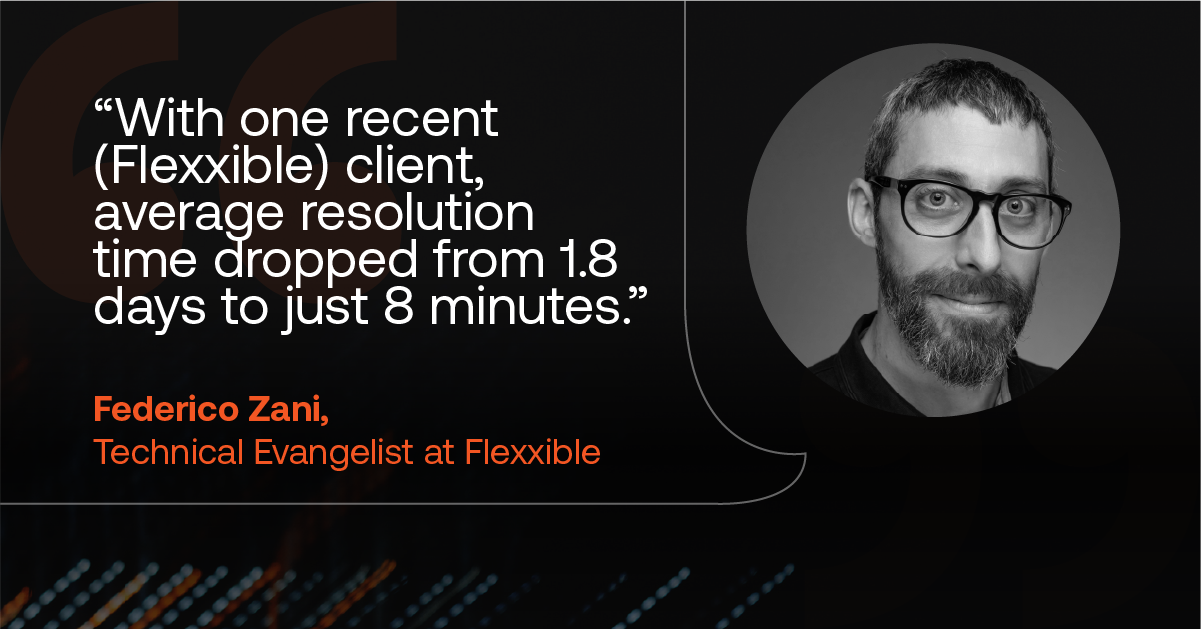
"With Flexxible, first-level support can remotely execute fixes directly on the professional's device, with no need for escalation,” says Federico Zani. “With one recent client, average resolution time dropped from 1.8 days to just 8 minutes."
Flexxible rolls out new functionalities to its entire customer base every two weeks – one of the fastest in the DEX industry – built on a continuous customer feedback loop, stays true to real business needs, not just enterprise-level priorities.
Organizations don’t need to take on full enterprise complexity at once, but instead optimise their investment as they scale, thanks to modular packaging: create your own bundle or take advantage of tiered packaging (Core, Advanced, Transform).
European organizations in healthcare, financial services, the public sector and other markets with strict compliance and data residency requirements find that Flexxible's European-built, Azure-hosted architecture to be the structural advantage they never saw coming.
Best for
European mid-market and enterprise organizations that need to move quickly and safely from detection to action. With a 100% recommendation rate from your fellow IT leaders on Gartner Peer Insights, trust is already built in.
2. Riverbed Aternity
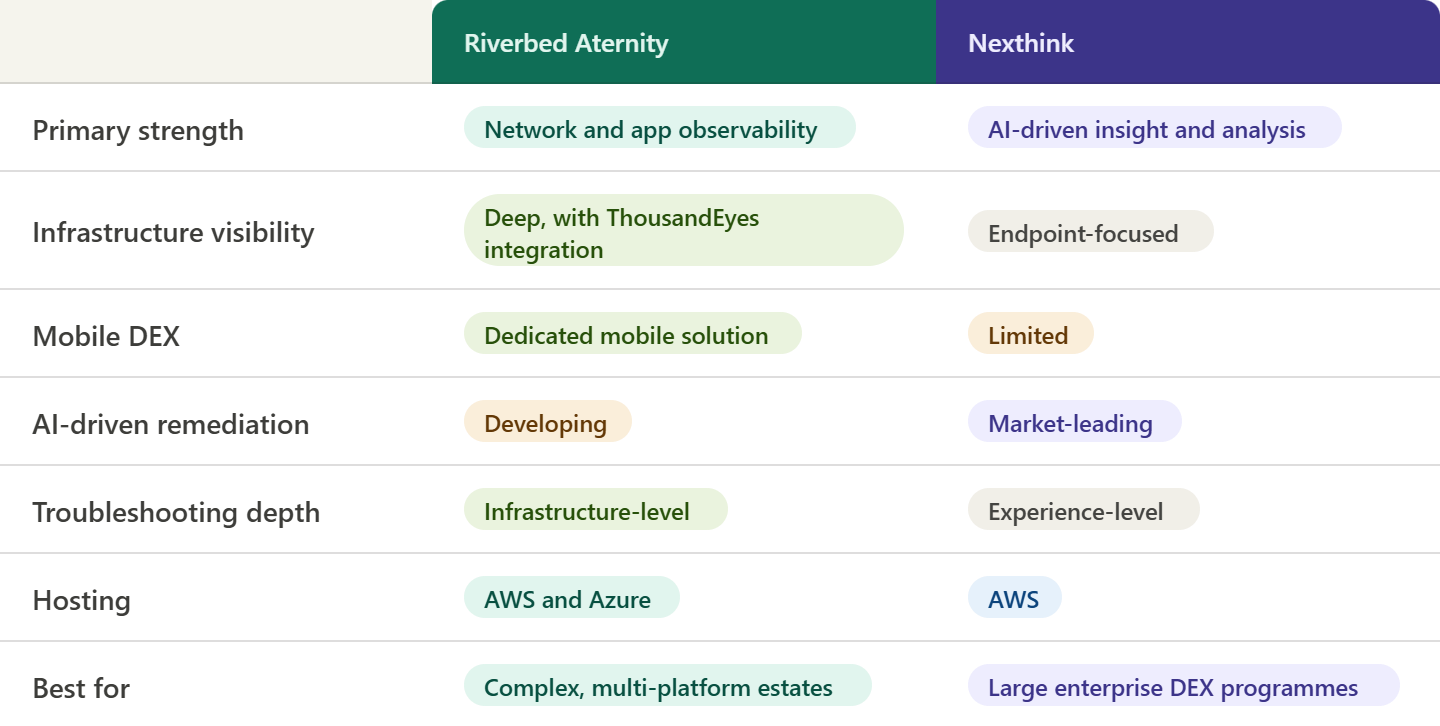
Riverbed Aternity is one of the most established names in digital experience monitoring with a globally distributed customer base. Its SaaS platform is hosted across AWS and Microsoft Azure.
Aternity stands out for two reasons. First, its deep observability across networks, applications, and endpoints.
Second, the platform’s ability to correlate endpoint metrics with broader infrastructure data is an advantage for IT leaders troubleshooting complex, multi-platform environments — particularly those where network performance directly affects user experience. Aternity also integrates with tools like ThousandEyes to deepen this visibility further.
Aternity also offers a strong mobile DEX solution, which is useful for companies with important field or frontline workforces.
Best for
Organizations seeking to align network and application performance data, with infrastructure-level troubleshooting as a top use case.
3. ControlUp
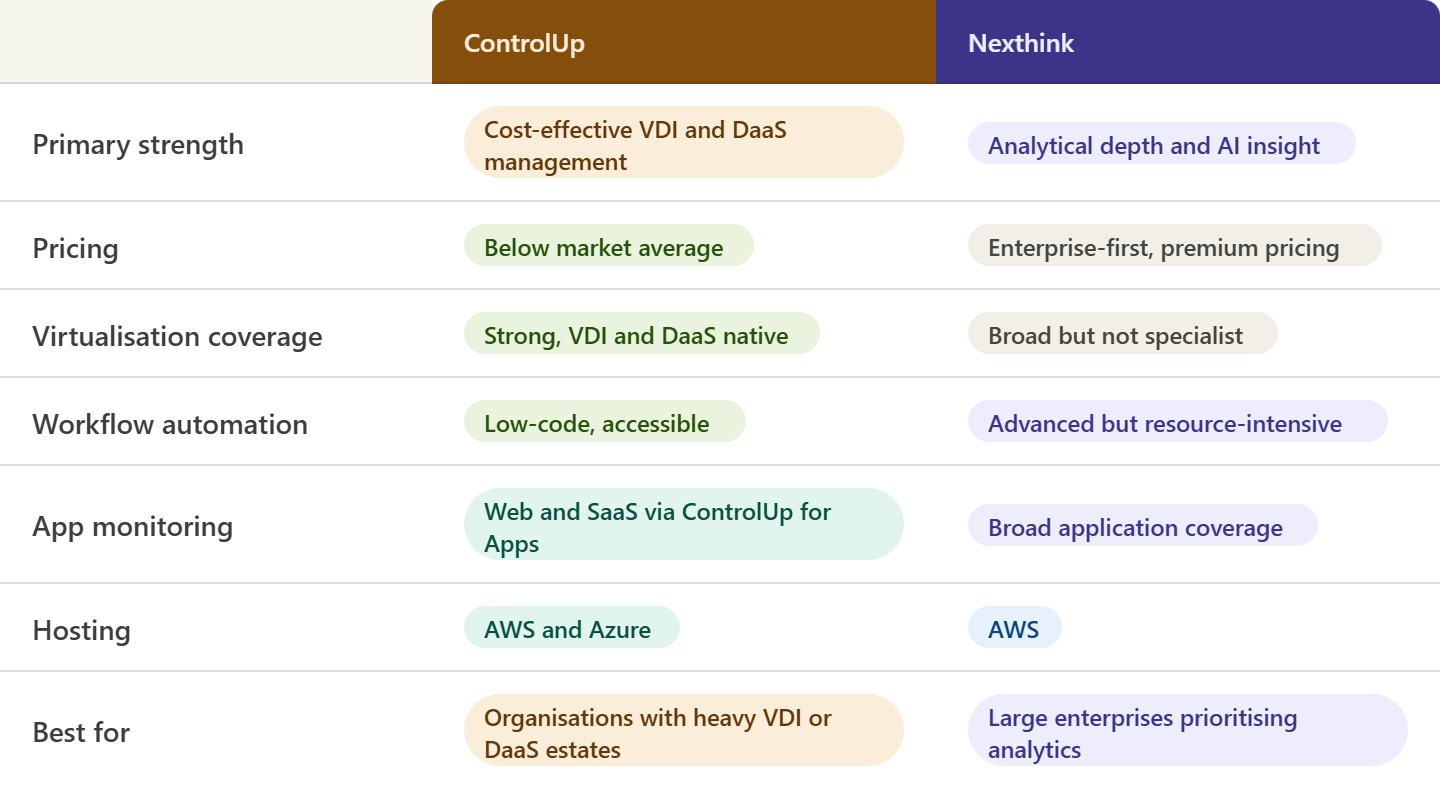
ControlUp is one of the most cost-effective platforms in the DEX world and is also a Leader in the 2025 Gartner Magic Quadrant.
Central to its service is its SaaS offering, which runs on both Azure and AWS. Its product strategy has expanded into endpoint management, applications, and UC monitoring. This works particularly well in complex digital workplace environments, particularly those with large VDI or DaaS deployments.
We can break down ControlUp's unified platform into two main pillars:
- Its recently launched Workflows product, which brings low-code orchestration to issue resolution and lets IT support build automations with a few technical resources
- ControlUp for Apps, built on its acquisition of Avanite, which lets leaders monitor SaaS and web apps.
Organizations find ControlUp’s discount package attractive, which offers discounts for larger bundles and multi-year commitments.
Best for
Enterprises struggling with heavy virtualization estates seeking strong workflow automation and expanding IT management capabilities at an affordable price.
4. 1E (now TeamViewer DEX)
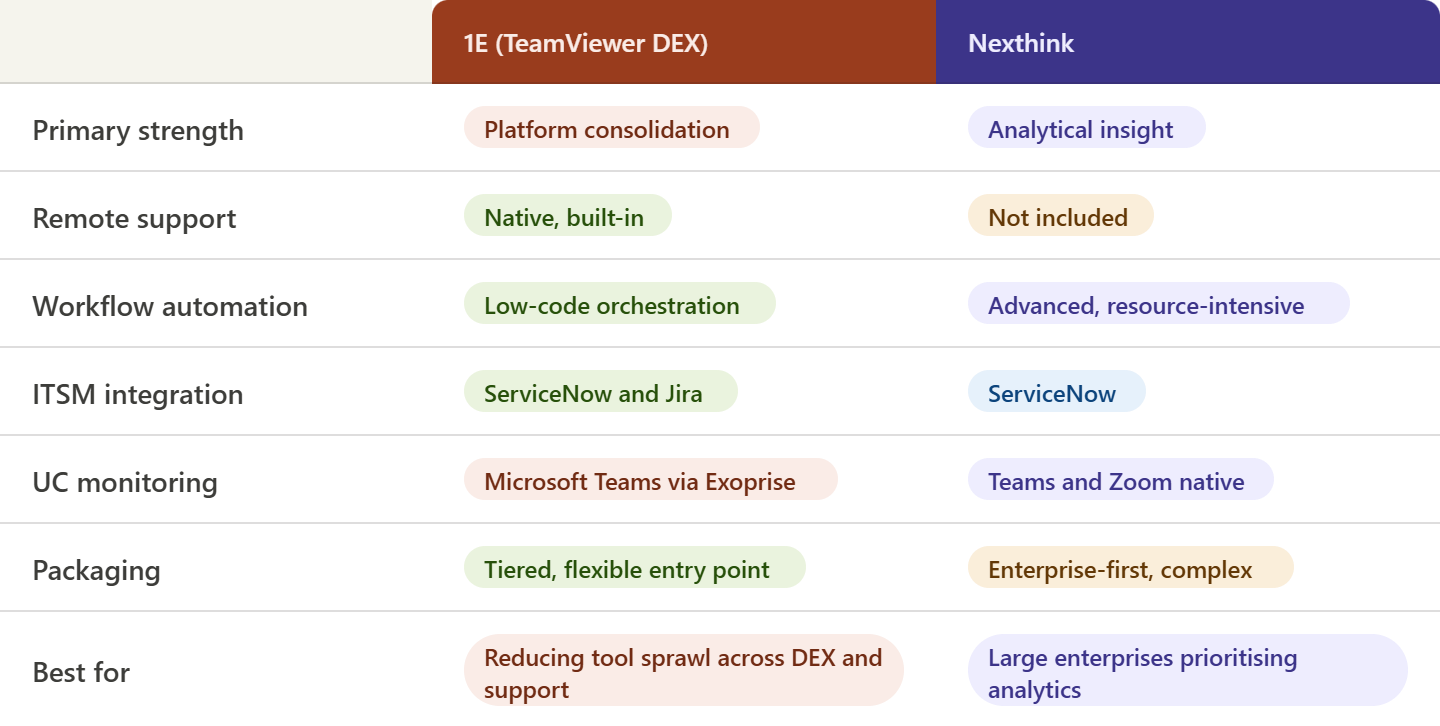
TeamViewer's acquisition of 1E marked a turning point for the company, bringing endpoint management, remote support, and DEX into a single platform.
The result is a platform that uses automated workflows and low-code orchestration to let IT teams spot and solve problems without a drawn-out escalation process. It integrates with ServiceNow and Atlassian Jira (covering enterprise IT service desk setups), as well as Exoprise, which brings UC monitoring, including Microsoft Teams, into the same console.
TeamViewer DEX also has a tiered pricing model, so you can start with a lean version that covers what your team needs, then add features as you expand your workflow. There’s also a range of use cases, so your IT team can quickly understand how it works and then help employees hit the ground running.
Best for
Enterprises seeking to manage remote support and DEX in one place, especially those already with TeamViewer or ServiceNow.
5. Lakeside Software (SysTrack)
Lakeside Software is a dependable SaaS platform and is one of the most experienced vendors in the DEX space.
Its SaaS platform, SysTrack, runs on Microsoft Azure and uses its Black Box data collection to keep a detailed historical record of endpoint and application performance. This helps it get to the root of issues quickly and reliably – a feature that matters enormously in regulated industries like healthcare or financial services, which require compulsory audit trails.
Lakeside also supports IT teams with ready-made success guides and office hours sessions that help them get more from the platform without a steep learning curve. It also slots into existing setups smoothly, thanks to integrated support for most operating systems, devices, and virtualized environments, without major disruption.
The one honest caveat: Lakeside updates its platforms more slowly than most competitors, operating at a quarterly release cadence. That gap may be starting to show in a market moving quickly towards AI-driven automation.
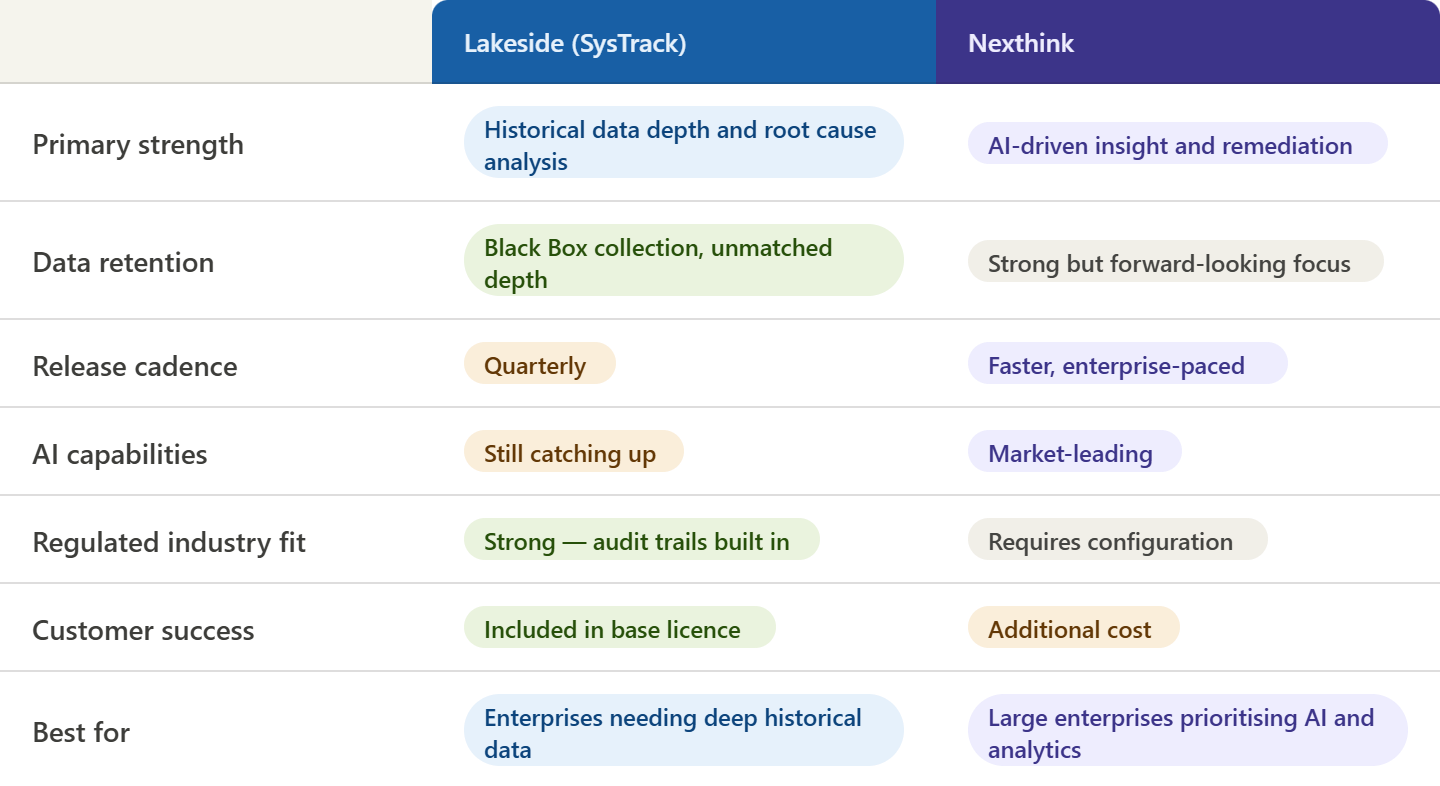
Best for: Enterprises that wish to use data for long-term resolution but do not need rapid delivery.
Flexxible: The Nexthink alternative trusted by leaders like you
Every platform on this list has earned its place through merit, but very few are endorsed by 100% of their verified reviewers in Gartner's peer review site for digital employee experience tools.
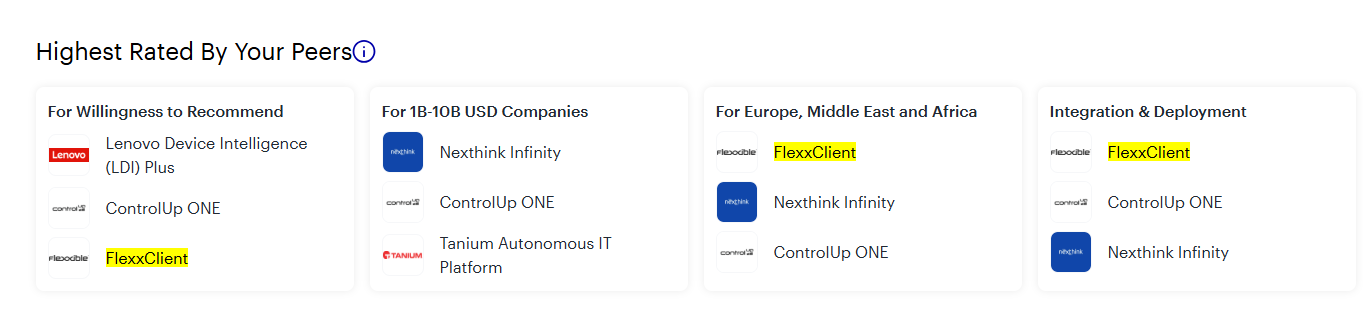
FlexxClient, run by Flexxible, leads across several vital DEX categories, including overall experience, because it fixes performance issues fast and keeps productivity as high as possible.
It does this by bringing multiple leading features into one console, including:
- Single-pane-of-glass visibility across thousands of endpoints and applications, turning fragmented data into meaningful metrics
- AI-powered, self-healing automation that recovers up to 78% of lost employee time by resolving common IT issues before users even notice them
- Native remote support so that even when IT teams need to intervene, they do so directly on the device, with no escalation or disruption
- Integrated compliance, so that GDPR and data residency demands are fulfilled from the start.
- Human-centric digital adoption support that gets your IT team using the platform confidently from the start
- Biweekly updates rolled out to every customer and not drip-fed to enterprise tiers first.
FlexxClient’s tiered packages are also designed to grow with you, so there’s no need to take on everything right away – simply take on what you need, then scale as your needs require.
All verified by the peers who've already made that call. If Nexthink was built for the biggest enterprises in the world, Flexxible was built for those that move faster than they do.
Ready to see Gartner's highest peer-rated European DEX platform in action? Book a demo today and find out why IT leaders keep choosing Flexxible over the rest.
*All platform comparison data is as of May 25, 2026
Recommended for you
- How to Make Wake on LAN Work For Your Business in 2026
- The Next Generation of RMM Is Here – and It's Called DEX. Here's How to Get Ready
- How to Optimize Productivity With These 5 Digital Workspace Essentials
- What is a Digital Workplace? How to Make it a Strategic Advantage in 2026
- How to Understand Gartner Digital Employee Experience in 2026: Which Platforms Are IT Leaders Backing?
- How to Turn Data Into Decisions With AI-Powered Reporting Tools
- What Digital Employee Experience Looks Like in 2026 (And How to Get It Right)
- Securing the New Office: Endpoint Management for a Hybrid Workforce

