
Digital workplace environments were meant to simplify work. Instead, many organisations have built ecosystems of collaboration and productivity tools that barely talk to each other.
These complex networks have created three immediate pressures for IT leaders, including:
- Poor visibility into real employee experience
- Escalating cybersecurity risk across distributed endpoints and teleworking setups
Low workforce adoption of expensive digital workplace solutions that were supposed to make things better.
To prevent this from happening, it’s important to know what an effective digital workplace should look like in today’s hybrid, data-driven enterprise environment. It’s only with a clear picture of this that IT leaders, including CIOs and IT operations directors, can start improving their digital workplace strategy.
Read on to explore what makes a high-performing digital workplace right now, and the solutions that are helping organisations finally deliver on their promise of digital transformation.
Contents
- What is a digital workplace?
- Digital workplace vs digital employee experience (DEX): What’s the difference?
- Why digital workplace strategies often fail
- How to improve your digital workplace strategy
- Turn your digital workplace into a strategic advantage with Flexxible
To work well, your digital workplace must be visible and optimised. Book a demo with FlexxClient to find out how you can transform your remote environment into a high-performing ecosystem.
What is a digital workplace?
At its simplest, a digital workplace is the ecosystem of tools, platforms, and technologies employees use to complete their tasks.
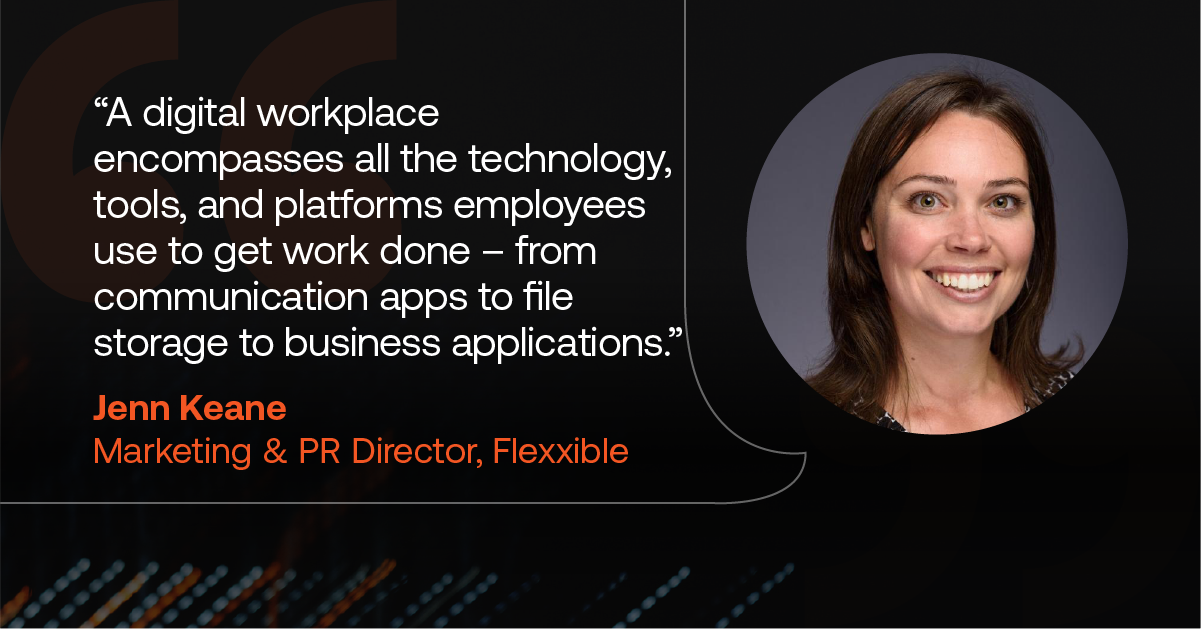
“A digital workplace encompasses all the technology, tools, and platforms employees use to get work done – from communication apps to file storage to business applications,” says Jenn Keane, Marketing and PR director at Flexxible.
To break this down, that includes all of the following, working together to support daily operations:
- Communication
- Collaboration
- Project and task management
- Knowledge and information
- Identity and access
- Productivity and creation
- Automation and integration
- Core business systems
When properly integrated and supported by real-time visibility, a healthy digitalised workplace is one of the main pillars in an organisation’s productivity, helping employees collaborate more effectively.
Yet this is more than just having the above tools available; it’s how well the organisation can make it work in terms of better experiences for employees.
This is where the Digital Employee Experience (DEX) comes into play.
Digital workplace and digital employee experience (DEX): How do they work together?
How Digital Workplace and DEX Compare
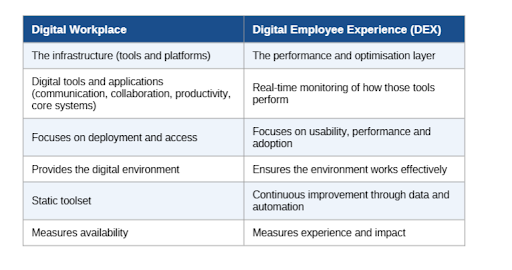
If we see the digital workplace as a city, then Digital Employee Experience (DEX) is the traffic system that keeps it moving efficiently.
“The digital workplace is your technology infrastructure – the what,” continues Jenn Keane. “Digital Employee Experience is the outcome – the how well. Many organisations invest heavily in digital workplace tools but struggle to understand why adoption is low, or productivity hasn't improved.”
As digital workplaces grow more complex, involving hundreds (if not thousands) of endpoints and layered authentication, it’s only natural that friction also increases. Applications slow down and workflows fragment – employees might find a workaround, but their digital experience deteriorates.
A digital workplace without DEX tools has no measurable performance, reliability, or satisfaction baseline. You cannot improve what you have not first benchmarked.
If this DEX drain is left unchecked, then it can spiral into serious operational issues that bring down productivity, including poor employee engagement and rising IT support tickets.
Why digital workplace strategies often fail
Digital workplace initiatives tend to fail because the growing complexity of a distributed workforce makes it too difficult for IT leaders to control, even after significant investment.
Here are three main symptoms of a misfiring strategy.
1. Hybrid complexity
Hybrid and remote systems are, of course, more complicated by nature. They must safely connect endpoints and workstations across home networks and corporate infrastructure, but this requires more authentication layers and tighter access controls.
Hybrid and remote work have multiplied endpoints, devices, and access points. Each new device adds cybersecurity strain, and each remote session increases authentication demands.
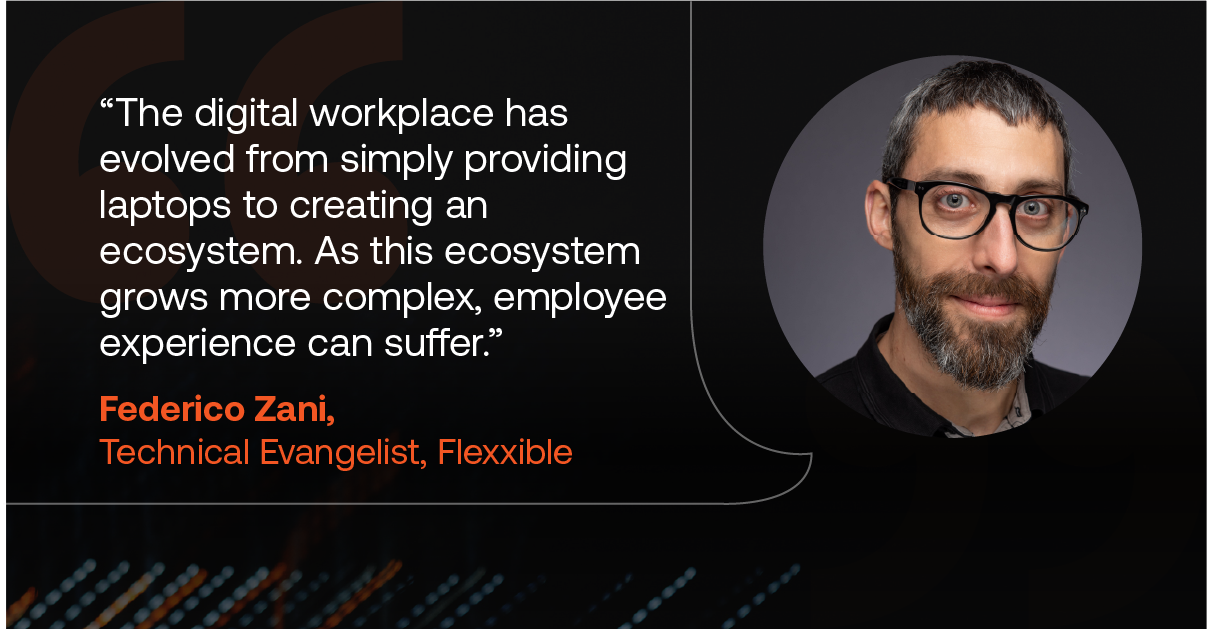
“The digital workplace has evolved from simply providing laptops to creating an ecosystem,” says Federico Zani, Technical Evangelist at Flexxible. “As this ecosystem grows more complex, employee experiences can suffer.”
2. Tool overload
Many organisations extend their operations by simply throwing more digital tools into the equation, ranging from new workflow systems to AI virtual assistants.
Yet without a cohesive framework behind it, this can quickly turn into tool sprawl where staff jump between instant messaging platforms, project dashboards, and intranets that don’t integrate cleanly.
The result? Shadow IT and, increasingly, shadow AI. A 2025 Gartner survey of cybersecurity leaders found that 69% of organisations suspect or have evidence of employees using prohibited public GenAI tools. By 2030, Gartner predicts that more than 40% of enterprises will experience security or compliance incidents linked to unauthorized shadow AI.
The digital workplace is exceptionally hard to manage when it becomes a fragmented ecosystem of workplace tools.
3. Lack of visibility
Ever tried driving through thick fog without headlights? Without real-time insight, IT teams are left in a similar situation.
Poor data analysis obscures what is really going on, leaving underperforming apps and friction hotspots under a cloud. IT teams try to see what’s going on, but it means service tickets rise and productivity drops.
Without active optimisation, even well-funded strategies can stall under their own weight.
How to improve your digital workplace strategy
The very best digital workplaces are the result of a concerted effort and are brought together through sensible planning and the right tools to make it happen.
With DEX as the barometer, the digital workplace becomes measurable, optimisable, and aligned with both operational performance and employee growth.
“DEX gives you visibility into the actual employee experience, which will help you build a highly functioning digital workplace. Are applications performing? Where are the friction points? What's blocking productivity? It transforms your digital workspace from a collection of tools into a strategic advantage."
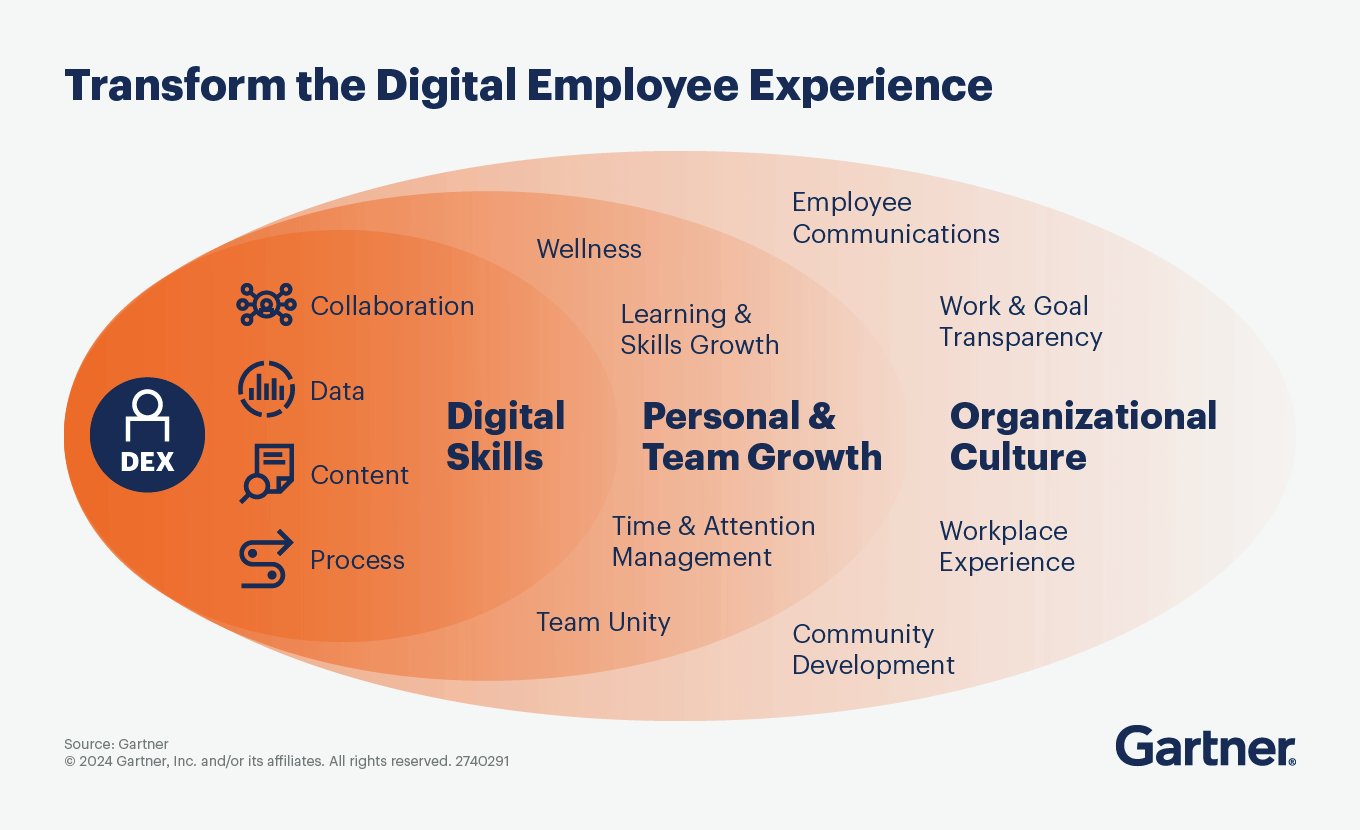
As Gartner’s model suggests, DEX sits at the centre of collaboration, data, content, and process — the operational heart of the digital workplace — and directly influences digital skills, team development, and organisational culture.
The Role of DEX In Digital Transformation
But what does a deliberate digital workplace strategy using DEX look like? Here are five core pillars that connect operational control with long-term transformation.
1. Benchmark before optimising
Many organisations rush into trying to upgrade systems without first establishing benchmarks. After all, if you don’t know what you’re measuring against, you can’t prove you’ve improved anything.
Before optimising a workplace, IT leaders need a clear baseline. They can get this by benchmarking:
- Current network latency and reliability
- Application performance and crashes
- Endpoint health and patch status
- Authentication success rates
- User friction signals
The best DEX tools give visibility in real time with hard data, instead of guesswork. Once an organisation knows this reality, it can start a continuous loop that helps a digital workplace to evolve instead of simply being a one-off initiative.
2. Prioritise what actually impacts performance
Once you have a clear view of where you stand, it’s tempting to try to fix everything at once but it’s better to just focus on the friction points that most dampen employee experience and productivity.
An IT leader might ask themselves questions like:
- “Is network latency slowing logins on Mondays?”
- “Which applications are crashing repeatedly?”
- “Are authentication failures increasing ticket volume?”
DEX data then lets leaders rank these issues by how much they impact the business. This targeted optimisation is an excellent way to get those visible wins that rebuild employee confidence in your IT systems.
3. Validate impact against your baseline
Actions are one thing, but they must be validated through further measurements.
Organisations should look at the impact that changes have had, whether it’s patching endpoints or streamlining workflows. Did ticket volume drop? Did login times improve? Has application stability increased?
DEX tools help to close this loop by comparing performance against your original benchmark and adding evidence-based outcomes to a digital workplace strategy. Factors such as reduced downtime, stronger employee experience, and better operational efficiency are now verified metrics.
4. Automate what works
Once an improvement proves effective, automate it.
The best DEX tools offer a clear route to automation, in the form of self-healing scripts, auto-remediation workflows, and AI-driven monitoring, so that issues get resolved before employees even notice. This makes quite the difference to hundreds of IT tickets piling up, like under old systems.
This paves the way from reactive support to the proactive digital operations that organisations must have to excel in their field.
5. Repeat the cycle and scale with confidence
A high-performing digital workplace is more of a discipline than a project. Within it, IT teams can easily identify new friction points, carry out verifiable improvements, then automate what works.
This continuous cycle is particularly important in today’s work of complex digital ecosystems and the expansion of hybrid work because it keeps employee satisfaction and performance on the same page.
When done well, it can produce a flywheel effect that helps a digital workplace automatically adapt, improve, scale – and help propel an organisation forward.
Turn your digital workplace into a strategic advantage with Flexxible
Digital workplaces can only be a success if leaders can see what’s happening beneath the hood. DEX tools, brought together in a mature DEX solution is the visibility engine that allows them to do this.
Staff complaints and rising ticket volumes are warning signs, but they often arrive after the issue has escalated, so it’s harder and more expensive to remedy.
An effective DEX solution, like FlexxClient, Flexxible’s flagship platform, continuously monitors the digital experience, using advanced data analysis to detect hidden bottlenecks.
It allows IT leaders not only to gain real-time visibility into endpoint health, application performance, and digital friction, but also to create reports with AI that translate raw telemetry into clear, executive-ready insight – before issues snowball into disruption.
Recognised as the leader in multiple categories in Gartner’s latest Voice of the Customer report, here’s how FlexxClient helps you move from firefighting to fine-tuning:
- 65% faster IT issue diagnosis
- 78% reduction in user waiting time
- 40% increase in employee satisfaction
- 25% savings on software licences
With unified visibility across Windows, macOS, Linux, Android, Chrome OS, and VDI digital work environments, IT teams get the full picture of how apps are performing and how healthy endpoints are.
Automated remediation and self-healing workflows fix issues quietly in the background, before they snowball into ticket avalanches. The service desk breathes easier, cybersecurity posture strengthens, and compliance stays on track.
The result? A digital workplace that runs smoothly instead of noisily – visible, optimised, and secure – so you get a powerful hybrid workforce that drives productivity and opens the door to scaling with confidence.
Ready to move to build a fully optimised digital workplace that maximises productivity? Book a demo and see how FlexxClient will transform your online environment into a measurable competitive advantage.
Recommended for you
- How to Understand Gartner Digital Employee Experience in 2026: Which Platforms Are IT Leaders Backing?
- How to Turn Data Into Decisions With AI-Powered Reporting Tools
- What Digital Employee Experience Looks Like in 2026 (And How to Get It Right)
- Securing the New Office: Endpoint Management for a Hybrid Workforce
- Unlock Hidden Microsoft 365 Savings: The Report IT Leaders Need
- The End of Windows 10 is Near: Are Your Endpoints Ready?
- Tired of Endpoint Chaos? Learn How to Regain Control
- How to Solve Remote Team Challenges with Digital Employee Experience
- The Best DEX Platforms to Improve Productivity, Security, and Engagement

