
Remote Monitoring and Management (RMM) was never designed for your organisation.
It was built for managed service providers (MSPs) juggling small business clients – not for IT leaders responsible for hybrid estates and the digital experience of thousands of employees across multiple locations.
If that mismatch is starting to show, then you may be feeling the pressure in the form of:
- Endpoint visibility that stops at the device and never reaches the employee
- Automation that handles routine fixes but can't handle the complexity of a hybrid estate
- No meaningful data to show leadership what IT performance actually costs the business
The simple fact is that your IT team isn’t to blame for these issues – it’s just your toolset belongs to a past generation.
This article explains why a widely used tool like RMM is being ousted by a new class of enterprise-grade platforms built around digital employee experience (DEX), and what that transition looks like for your organisation in practice
We’ll cover:
- What are RMM tools, and what are they built to do?
- Where RMM breaks down at enterprise scale
- The hidden cost of running the wrong tool
- What DEX is — and why it's the logical next step
- How to know you've outgrown your RMM tool
- Stop managing endpoints, start measuring business performance with Flexxible
Flexxible is your gateway into a new era of enterprise IT. Book a demo to find out you can measure business performance across a diverse remote workforce.
What are RMM tools, and what are they built to do?
RMM kick-started a revolution when it arrived in the early 2000s. Up until that point, a service provider had to travel to the client site to fix a problem, and they billed for time and materials based on their hourly rates.
With RMM software, they could start to monitor, manage, and fix endpoints from a distance. Not only that, but they could monitor hundreds of devices at the same time and patch and secure systems, without sending out engineers to each individual location.
Over the years, RMM tools have evolved, so that a modern RMM platform can:
- Give remote access to endpoints operating on Windows, macOS and Linux environments
- Detect vulnerabilities early and send out automated patches
- Monitor devices in real time via dashboards and SNMP-based alerting
- Deploy scripts for routine IT tasks
- Manage antivirus protection and basic security measures
- Automate patch management and vulnerability detection
- Track performance against SLAs and produce service reports for managed service clients.
RMM helped businesses move out of an era of reactive IT support, where an engineer only gets involved if something breaks. Instead, it allowed them to continuously monitor endpoints remotely, so MSPs could identify and resolve issues, often before users even noticed them.
The problem is, enterprise IT has progressed far beyond the environments RMM was designed to serve – and the latter has struggled to keep up with this scalability.
Where RMM breaks down at enterprise scale
RMM broke boundaries when it helped organisations monitor hundreds of small client environments simultaneously from a single pane of glass, yet it has its limits.
Modern hybrid workforces now span tens of thousands of endpoints, across physical offices and remote workspaces. Traditional RMM architecture has been left behind, and the cracks are starting to show.
Here’s how.
1. Visibility
Log onto any RMM dashboard, and you’ll find data on CPU performance, connectivity status, and patch compliance. Yet these are all superficial: they stay at device level.
There is no experience layer, where you can capture how employees actually feel about the technology they're using day to day, and no way of showing how endpoint health is affecting their morale or productivity.
A device could flash up as “healthy” on your RMM console, yet the person behind it is losing an hour a day to app crashes and failed authentication loops.
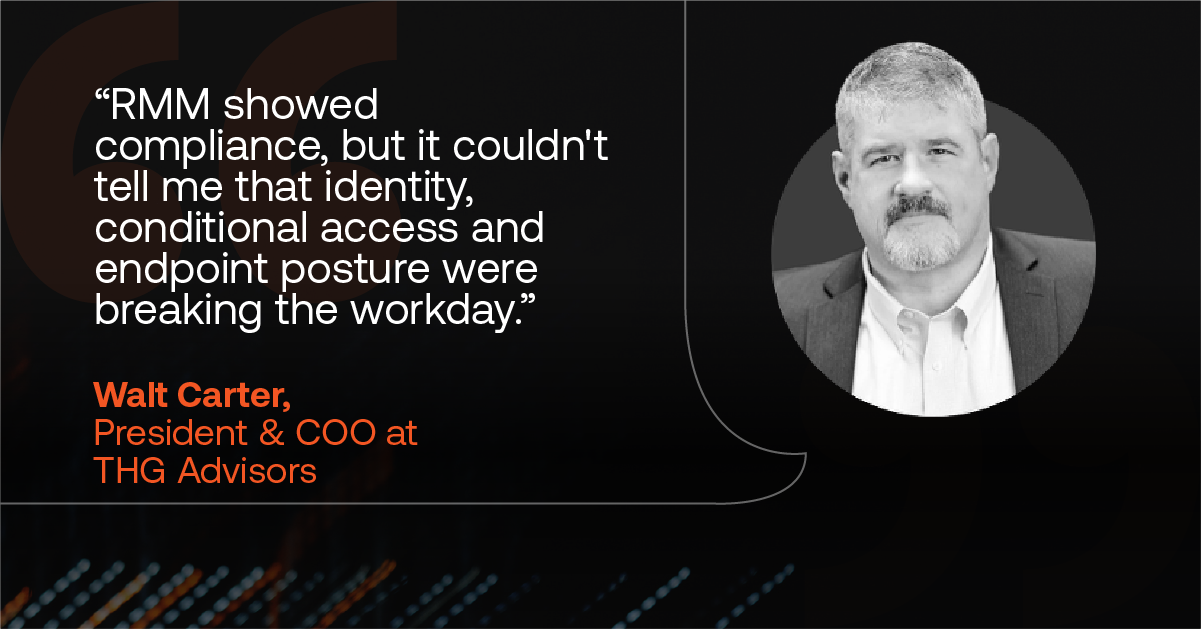
"We pushed a security and patch policy during a rollout and got a wave of exec complaints: Teams, SSO and MFA kept re-prompting, and VPN profiles got disrupted, “says Walt Carter, President & COO at THG Advisors and former CIO at organisations including Fidelity and Gannett. “RMM showed compliance, but it couldn't tell me that identity, conditional access and endpoint posture were breaking the workday.”
The above is not an edge-case scenario, but a limitation of a platform that measures device compliance, not the human experience behind it.
As an IT leader, you’re flying blind (or at least partially sighted) because you don’t know whether your IT estate is enabling your workforce or quietly undermining it.
2. Automation
RMM automates scripts very well. These tend to be routine, predictable tasks in relatively uniform environments.
In the world of hybrid estates, however, there are now edge cases that predefined scripts cannot handle. Automation has progressed to deal with these, but RMM hasn’t kept pace. Instead, it stays tethered to a scripting model that was designed for simpler, more predictable environments than most enterprises now run.
This causes scripting to hit a brick wall and issues either escalate to the service desk or simply go unresolved.
3. Integration
RMM normally runs alongside several important tools, including a PSA (Professional Service Automation) platform, separate antivirus tooling, firewall management and network monitoring.
These systems are often poorly synced, so they produce fragmented data and SLA reporting needs many labour hours to reconcile. Across a remote workforce, manually reconciling siloed data and producing reports becomes a gargantuan task.
IT leaders see that this unintegrated ecosystem causes downtime, but its cost to the business (in lost productivity and missed commitments) is much harder to grasp.
RMM tooling was simply never built to produce that data.
4. Security
RMM tools need deep system access privileges by their nature. All well and good, but this means they become an attractive first-stage target for cyberattacks.
Just look at how malicious campaigns using RMM tooling (like ScreenConnect and Atera) increased by nearly fivefold in three years, between 2022 and 2024.
The 5x Increase in Malicious Campaigns Using RMM Tooling (2022-2024)
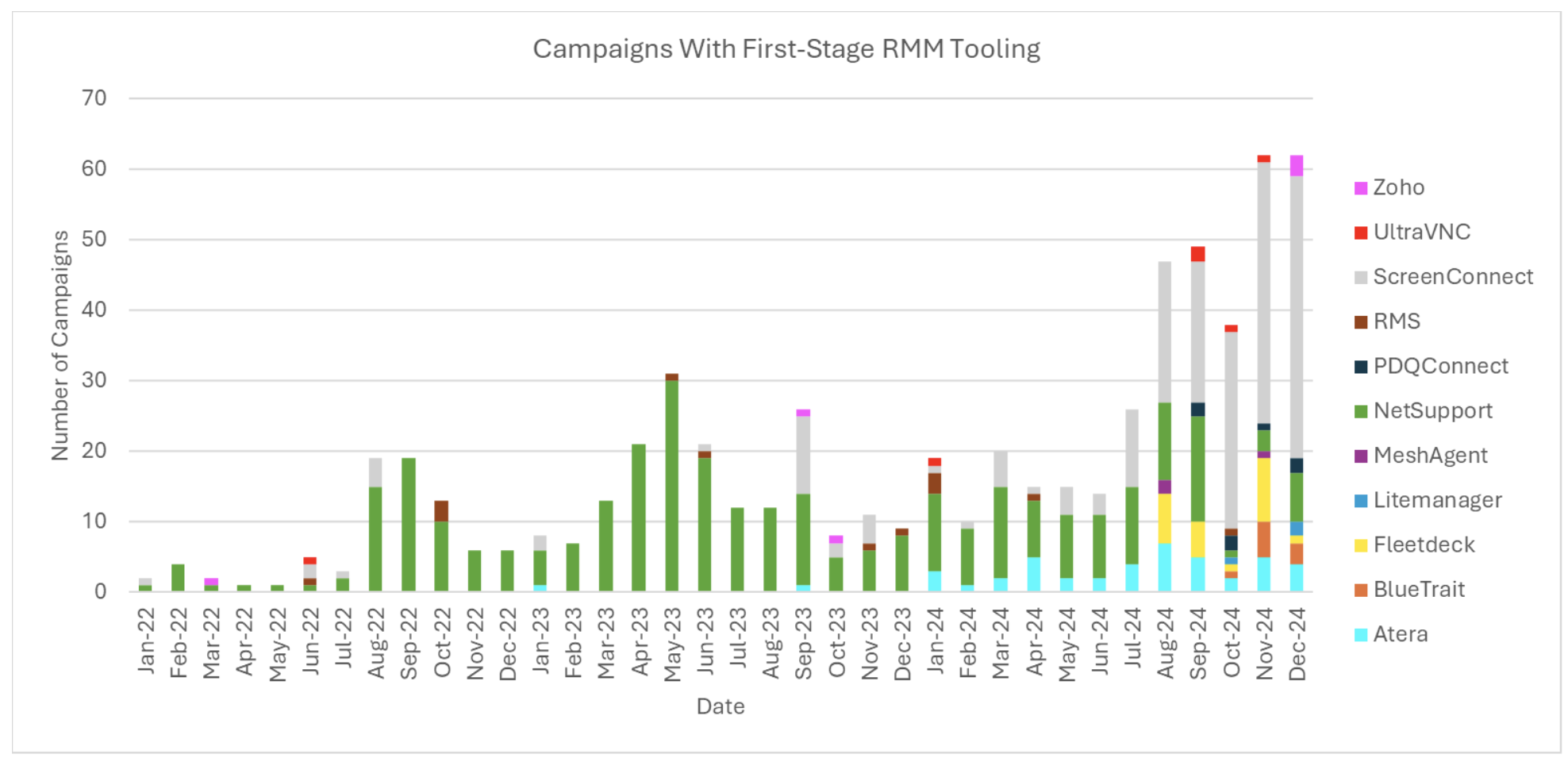
This does not make RMM unsafe, but the more RMM agents at play across a fragmented, multi-tool estate, the more potential entry points an attacker can target.
The cost of this vulnerability is one that many enterprises are only beginning to calculate, and this outlay tends to appear in unexpected places.
The hidden cost of running the wrong tool
The licence fee is the visible part of the cost iceberg. Beneath the surface, there’s a mass of hidden operational costs that come about from running a sprawling enterprise on tooling that wasn’t built for it. The longer you stay on the wrong platform, the more it drags you down.
1. Digital friction
Connectivity drops, app failures, slow logins – these are all issues that IT typically never hears about because employees have learned to absorb them. Yet, these losses compound into huge productivity deficits across a large remote workforce.
Let’s say each employee across a headcount of five thousand loses an average of just 15 minutes of daily productivity to digital friction. That’s 1,250 hours, or 52 days, of working time that the organisation loses every 24 hours.
IT opportunity costs sit on top of that. Engineers spend their days firefighting ticket-driven issues; time they could spend on improvement tasks. Burnout is a real risk, often prompting experienced professionals to leave, taking knowledge out the door with them.
2. Onboarding
Onboarding is another pressure point that rarely appears in a tool evaluation.
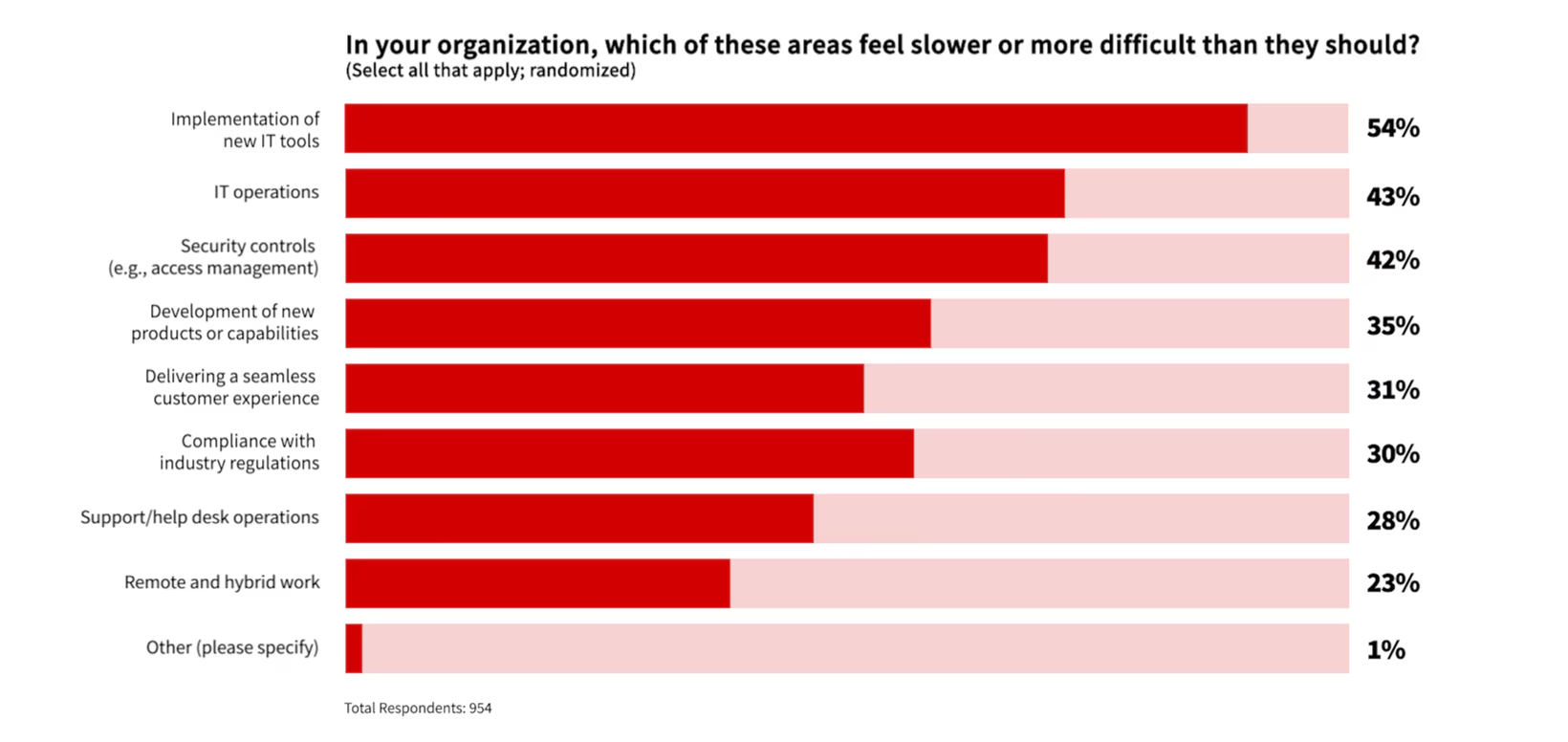
According to CDW research, over half (54%) of IT decision-makers already say that implementing new IT tools feels slower or more difficult than it should, and that's before we take into account the complexity of doing it manually.
How Bringing in New Tools Is A Top Source of Frustration for IT Leaders
Without automated endpoint management, provisioning a new employee (particularly a remote one) becomes a minefield of potential errors that delay productivity from the first day.
3. The SLA gap
SLAs (Service Level Agreements) are made up of commitments IT departments make to the business based on what their tooling should, in theory, deliver.
RMM tools often fail to live up to these intentions as they struggle with complex hybrid ecosystems. Longer response times and recurring issues are the symptoms that cause a fading confidence in IT.
A failure to meet SLAs often makes it to the boardroom level. As a CIO, you’ll find that it’s tough to defend headcount or investment when your endpoint management platform cannot produce data that connects IT performance to business outcomes.
What is DEX? The new generation of endpoint intelligence
If we think of an enterprise IT estate as a building, then RMM is the solid foundation of it, the essential infrastructure that helps an organisation keep its systems running and its remote workforce connected.
DEX is the floor built on top of it, and the people in it. Yet where RMM monitors the structure, DEX watches the occupants, and measures whether the building is actually working for these people, as well as how much it costs when it isn’t.
For enterprises managing hybrid workforces – and the VDI sprawl and AI-driven operations that come with them – this upper floor is now a necessity.
How DEX goes further than RMM
DEX builds on RMM solutions to deliver something the latter was never designed to produce: insights into the digital employee experience behind the technology your company uses.
We can break this down into three key areas.
1. Cross-platform visibility
Instead of simply telling you that each workspace environment is up and running, a DEX platform tells you how one is performing compared to the rest.
Let’s say you have a team running virtual desktops in a regional office that’s experiencing worse app performance than the rest of the organisation. A DEX dashboard will:
- Correlate the issue with experience scores and productivity proxies across the affected cohort
- Trigger automated remediation where possible
- Escalate the areas that can’t be remediated to your IT team with full context.
In short, DEX will tell you what’s running badly, for whom, and at what cost to the organisation – all well beyond the scope of RMM.
2. Experience intelligence
RMM has no way of capturing how your staff feel about the tech they use.
DEX platforms collect real-time employee feedback on their technology experience, surfacing issues that never generate a support ticket but nonetheless affect productivity and engagement.
Rather than device-health metrics alone, DEX platforms for enterprises produce quantified experience scores at the individual, team and organisational level — giving IT and leadership a shared language for measuring digital performance.
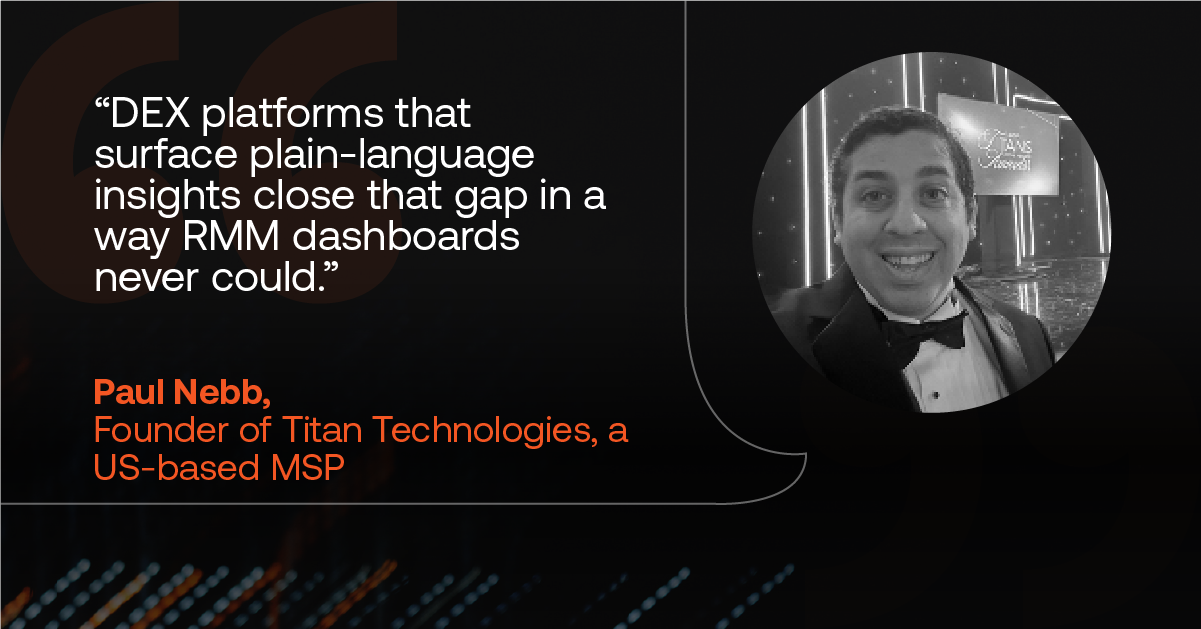
"The biggest gap I see isn't technical – it's translation, “ says Paul Nebb, founder of Titan Technologies, a US-based MSP. “DEX platforms that surface plain-language insights close that gap in a way RMM dashboards never could."
3. Proactive self-healing
Where RMM automation responds to known scripts, DEX platforms identify patterns and remediate issues before employees notice them – a clear shift from reactive to proactive IT operations.
This lets IT teams tackle problems on the front foot, nipping problems in the bud before they grow into the kind of incidents that consume entire IT workdays.
4. Business-aligned reporting
One of the biggest jumps from between RMM and DEX is the actionable data it produces and the different facets of organisational leadership that can act on it
RMM was excellent for providing granular intelligence on endpoint performance, but DEX takes it further by connecting it to workforce productivity and quantifying in terms that finance, HR, and senior executives can see clearly.
This type of reporting can make all the difference if you’re a CIO who must defend headcount or justify investment in the IT infrastructure that keeps your organisation running.
How to know you've outgrown your RMM tool: 4 key questions
The well-established benefits of an RMM platform means that organisations often get along fine without realising that a change would be in their best interests.
Yet across a large virtual workforce, digital friction can accumulate so that, before you know it, you have a platform that's working harder to keep up with your environment than it is to improve it.
Here are four questions that will give you a clear picture of whether it’s time to move past your current tooling.
1. Can your current tool tell you how an IT issue affected employee productivity, not just uptime?
Many IT leaders make the mistake of confusing uptime with productivity, but a device can still be online while an employee loses hours.
If all you can see is device status and ticket resolution time, but not the human impact behind the numbers, then you have a visibility gap that could be costing your business more than the IT reports show.
2. Does your remote management cover virtual desktops, cloud workspaces and physical devices from a single console?
Jumping between platforms to build a complete picture of your digital workplace is a standard process for many enterprise teams, but it takes time and cognitive power that they could use elsewhere.
More importantly, it creates fragmented troubleshooting, which slows down resolution and often adds to vulnerabilities.
3. Can you produce a board-level report on digital experience without manually compiling data?
If the answer is no (or not without significant effort), your IT management platform is not generating the right data and has out-of–date reporting features.
Modern platforms now have automatic reporting capabilities which streamline experience data, productivity signals and endpoint performance into a single, board-ready view.
4. Is your IT team able to get ahead of problems before they escalate?
An IT team stuck in firefighting mode is suffering from a lack of proactive automation that resolves issues before they become major incidents.
If you answered no to more than one of these, the gap between your tool's maturity and your environment's complexity has become a business problem, not just an IT one.
Stop managing endpoints, start measuring business performance
It’s easy to think that the leap to DEX means starting from scratch, but you don’t need to dismantle the RMM capabilities that you’ve built up.
Flexxible’s enterprise DEX solutions layer onto existing workflows and toolsets, so that you can replace components at your own pace, instead of shocking your organisation with wholesale change.
Here’s how the transition could work in practice:
- Phase 1. Visibility. From the first moment, Flexxible gives you a unified view of physical devices, virtual desktops, and cloud-based workspaces from a single dashboard.
- Phase 2. Automation. Our platform’s automated management and support give you the power to self-heal, resolving issues without generating tickets and slashing resolution times. We connect with existing ITSM platforms, security tools, and SaaS apps via open API integrations so you don’t need to replace them before time.
- Phase 3. Intelligence. Create reports with AI and get board-ready insights from complex IT data in seconds.
The results speak for themselves. Across nearly 1 million endpoints worldwide, FlexxClient delivers:
- 78% of support time reclaimed by users who would otherwise be waiting on IT
- 65% faster IT issue diagnosis
- 40% increase in employee satisfaction
- 25% savings on software licensing
Built under European regulations and recognised in the latest report on Digital Employee Experience by Gartner, Flexxible is the only comprehensive SaaS platform that combines automation, digital experience and regulatory compliance, with deployment support from day one.
The RMM revolution is over. For enterprise IT teams managing hybrid workforces at scale, Flexxible is what comes next.
Flexxible lets you measure, manage and improve the digital experience of every employee across your entire estate, from a single platform. Book a demo with us to find out howe we can take your organisation to the next level.
Recommended for you
- How to Optimize Productivity With These 5 Digital Workspace Essentials
- What is a Digital Workplace? How to Make it a Strategic Advantage in 2026
- How to Understand Gartner Digital Employee Experience in 2026: Which Platforms Are IT Leaders Backing?
- How to Turn Data Into Decisions With AI-Powered Reporting Tools
- What Digital Employee Experience Looks Like in 2026 (And How to Get It Right)
- Securing the New Office: Endpoint Management for a Hybrid Workforce
- Unlock Hidden Microsoft 365 Savings: The Report IT Leaders Need

