The Apps that Run Your Business are Failing Silently. Until Now.
Digital friction in critical web applications rarely reaches support: employees adapt and the problem stays invisible to IT. Flexxible Web Apps closes that blind spot by measuring performance from the employee’s browser, in real time.
%20-%2027-04-2026%2011-09-42.jpeg)
In digital workplace management, there’s a type of problem that rarely shows up on IT dashboards: critical web applications that run slowly, fail intermittently, or have access issues that employees eventually accept as just part of the day. They don’t generate alerts or leave visible traces in server logs — and yet their impact on productivity is constant. At Flexxible, we've built Web Apps to make exactly that visible.
The problem that never reaches support
When an application is slow to load, the most common user response isn’t to open a ticket. It’s to refresh the page, mention it to a coworker, and move on. The IT team doesn’t see the problem, not because it doesn’t exist, but because it never reaches them as a formal incident. It shows up as lost productivity and a vague sense that the tools aren’t working as they should, but without concrete data to act on.
"Most digital friction never reaches IT because employees adapt instead of escalating."
— Dan Wilson, Gartner, 2026
The challenge isn’t just fixing problems when they appear — it’s having the visibility to detect them before users have normalized them. And that requires measuring from where they actually happen: the employee’s browser, not the server.
Critical web apps aren’t just "web pages"
When we talk about web applications in a business environment, we’re talking about the ERP used to manage orders, the CRM where every customer relationship lives, the HR portal that the entire workforce relies on, or the financial tool that has to work flawlessly at month-end close. These applications are critical infrastructure, not accessories, and they need to be monitored with the same rigor as a server or a network.
The key difference lies in the vantage point. A server can respond perfectly while an application takes 15 seconds to load for a user at a remote office. That gap — invisible from theinfrastructure side — is exactly where the real problems live.
What is Web Apps and what does it measure
Web Apps is Flexxible’s feature built to monitor web application behavior from the end user’s perspective. Not from the server, not from the network in the abstract — from the employee’s browser, on their device, under their real working conditions. It captures perceived load times, access errors, and gradual performance degradation: the kind of signals users notice long before any alert appears intraditional monitoring systems.
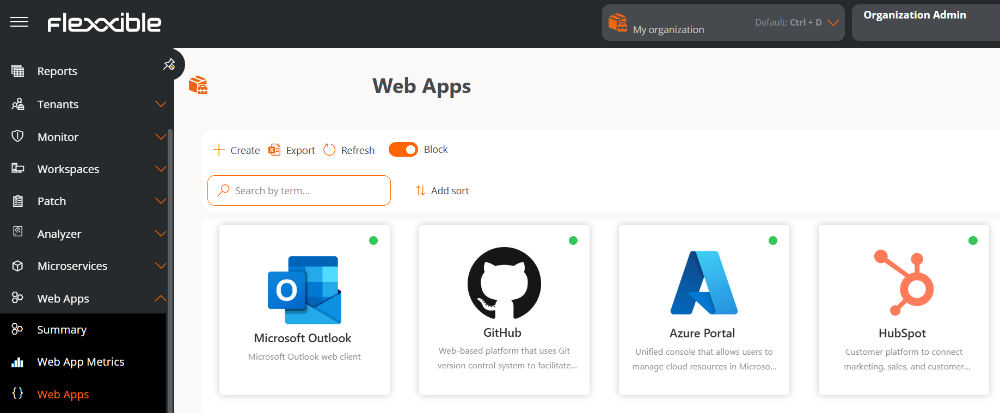
One of its most valuable capabilities is the ability to segment data by network or reporting group, enabling far more granular analysis. With that, it’s possible to detect failure patterns, assess perceived performance across different user groups, and make informed decisions, without waiting for someone to proactively report the problem.
Who benefits from this feature?
IT Directors and Digital Workplace Leaders
They get real visibility into how critical applications behave under actual usage conditions: with enough data to prioritize investments, justify improvements to the business, and negotiate SLAs from a position of knowledge, not intuition.
Support Teams
When a user reports that “something feels slow,” the team already has context: when the problem started, which users are affected, and whether there’s a pattern. That cuts down diagnosis time and eliminates several rounds of unanswered questions.
Enterprises
Fewer interruptions to the tools that power daily work, and greater operational continuity, without relying on someone having reported the problem first.
From symptom to diagnosis
Picture a support team starting to receive scattered complaints about ERP slowness. Without visibility into the application’s behavior, diagnosis starts from scratch: Is it the server? The network? The device? With Web Apps, that same scenario looks different: the data already shows the problem started three days ago, that it affects only users at a specific office, and that load times have been climbing steadily .What used to be a vague anecdote becomes a concrete, actionable diagnosis.
The focus is the application, not the user. The goal is to ensure critical tools work as they should — with real data instead of assumptions.
How it works in practice
Web Apps relies on two components of the Flexxible ecosystem: the FlexxAgent, installed on the endpoint, and the Flexxible Web Apps browser extension, available for Chrome and Edge on Windows and Linux (Mac coming soon). Deployment integrates with each organization’s existing management tools — whether GPO, Microsoft Intune, Flexxible’s own tools, or other corporate solutions — with no additional infrastructure required.
Activation is granular and managed from the Flexxible Portal: it can be enabled globally or scoped to specific reporting groups. Once the extension is installed, data collection begins on the next browser restart.
Closing the loop
Infrastructure and endpoint monitoring are mature in most organizations. The missing link was what connects both to the real employee experience: what happens inside the browser, with the application they use to get work done every day. Web Apps closes that loop. Because what employees have normalized will keep happening until someone decides to measure it and act on that data.
For more information, check the technical documentation or join our next LinkedIn Live to see it inaction on real business applications.
Recommended for you
- The Next Generation of RMM Is Here – and It's Called DEX. Here's How to Get Ready
- How to Optimize Productivity With These 5 Digital Workspace Essentials
- What is a Digital Workplace? How to Make it a Strategic Advantage in 2026
- How to Understand Gartner Digital Employee Experience in 2026: Which Platforms Are IT Leaders Backing?
- How to Turn Data Into Decisions With AI-Powered Reporting Tools
- What Digital Employee Experience Looks Like in 2026 (And How to Get It Right)
- Securing the New Office: Endpoint Management for a Hybrid Workforce
- Unlock Hidden Microsoft 365 Savings: The Report IT Leaders Need

