
Modern endpoint management tools give organizations a lot of information. As a CIO or IT leader, you can now see whether a device is enrolled, patched, encrypted, or compliant from afar.
Yet a laptop can pass every check you run on it and still ruin someone’s morning.
This is because most endpoint management tools don’t tell you vital employee data, including:
- The employee’s experience when using the device
- How quickly technical issues are being resolved for them
- The digital friction that flies under the radar yet still costs hours of productivity each week.
Such blind spots can be extremely damaging. Frustrated employees are unlikely to produce their best work, but you’re unlikely to realize it if your platform dashboard stays green.
The best endpoint management platforms make these blind spots visible. They not only let you gauge the experience behind the device, but fix the issues before the employee complains or even notices.
This article looks at seven popular examples of endpoint management platforms, and how they hold up at scale, including device coverage, automation depth, and how they stay compliant.
We’ll cover:
- What does unified endpoint management look like right now?
- What are 7 popular endpoint management software examples?
- What are the criteria for choosing an endpoint management solution for large enterprises?
- What does an endpoint management platform cost?
- Endpoint management in Spain: Where Flexxible has the advantage
FlexxClient shows you every endpoint in your estate, including the ones missing from your compliance report, and fixes what it finds automatically. Book a demo here.
What does endpoint management look like right now?
Modern endpoint management comprises four layers that run side by side across large IT estates.
1. Device control
This is the oldest capability and covers software deployment and updates, patch management, and security policies across laptops and mobile devices. Mobile device management (MDM) and traditional client management for desktops and laptops are the two main pillars of device control.
2. Unified endpoint management (UEM)
UEM bridged the split between mobile devices and everything else. It brought the idea of a centralized console for all types of devices, including, increasingly, IoT (Internet of Things). Enterprise Mobility Management (EMM) has evolved as a stepping stone but has since been absorbed into UEM, which is what many vendors sell as a baseline.
3. Endpoint security
Endpoint security has progressed to keep up with endpoint technology, and includes endpoint protection (EPP) and endpoint detection and response (EDR) to guard against the following cyber threats:
- Malware
- Ransomware
- Phishing
- Cyberattacks on unmanaged or personal devices (BYOD)
These security features work in tandem with controls that contain the damage, such as firewall, VPN, access control, and data loss prevention.
4. Digital employee experience
The digital employee experience tells us how the employee feels about the endpoint while they’re using it, and is a vital metric when it comes to increasing productivity because it tells us where an issue is brewing before it evolves into a major problem.
The DEX score shows IT leaders how to measure digital employee experience. This is a composite of the above telemetry and direct feedback, which organizations can track and use to spot where friction is building before tickets start to arrive.
What are 7 popular endpoint management software examples?
If you’re an IT leader responsible for carrying out an endpoint management platform comparison, then you may find the task to be complex and time-consuming. There are many different aspects to consider, and the differences that matter at scale rarely show up on a spec sheet.
To make this easier, here’s a look at seven of the most prominent endpoint management platforms for IT estates on the market today.
1. FlexxClient (Flexxible)
FlexxClient, run by Flexxible, is a European platform that optimizes endpoint management by providing one experience view across physical and virtual workspaces, and using automation to resolve issues before employees notice them.
As an CIO or IT leader, you can track devices and applications in real-time from a unified console. From here, you’ll see live data (CPU, RAM, GPU and latency) alongside historical patterns which locate where performance issues start to creep in. FlexxClient triggers remediations automatically, and first-line support can turn repeatable fixes into low-code workflows without escalating.
Security comes embedded at workspace level, including endpoint protection, compliance and support, while a ServiceNow integration connects it to your existing service desk.
The platform detects 65% of issues faster than conventional monitoring, and resolves up to 19% of tickets automatically: two gains that contribute to a 78% recovery of lost employee time.
Best for: Mid-market and enterprise estates looking for experience data, automation, and compliance in one package, especially those concerned with European data residency and multilingual (English, Spanish, Catalan, and Portuguese) support.
2. Ivanti Neurons
Ivanti puts consolidation at the heart of its product. Its platform brings endpoint management, asset discovery, security, and the service desk into one place, so a device that fails a patch check can open its own ticket and close it again. Its remediation bots run against Windows, macOS and Linux, and they also hook into either Ivanti's own ITSM or ServiceNow.
There are two things to look out for. First, mobile data arrives secondhand via integrations instead of from an agent, and secondly, virtualization support comes from installing Ivanti’s software on the virtual desktop itself, which tells you how the device is performing but not much more.
Best for: Organizations already signed up to Ivanti that wish to cut vendor count.
3. Tanium
Tanium answers questions about 100,000 endpoints in about the time it takes to answer one. This covers experience data, configuration, patch state, and compliance, which brings the device security posture and performance into the same view. Tanium Automate costs nothing extra and handles remediation, while a ServiceNow integration covers tickets and assets.
That said, the coverage is narrow: Windows and macOS, and nothing turnkey for virtual desktops, Teams, Zoom or phones. Gartner notes DEX-specific updates were minimal last year, with the major releases going to the broader platform. rates the DEX product behind the rest of this list on maturity.
Best for: Security-led IT teams who already own Tanium.
4. Microsoft Intune
Intune is already common across organizations, but it comes with analytic capabilities that help surface endpoint performance without another purchase.
Endpoint Analytics assesses how well devices are performing and any basic anomalies that provide a cause for concern. Advanced Analytics goes deeper, reporting on device reliability and automating common-issue remediation as an add-on. Users can now also get virtualization support across Windows 365 and Azure Virtual Desktop, as well as ServiceNow integration.
Intune is great at confirming device state, but the reporting lags instead of running live and there isn’t a clear route to fixing problems. You might know the device has a problem, but will need to resolve it elsewhere.but it doesn’t collect sentiment or send outbound engagement, so it’s difficult to see what devices are doing without ever hearing from the people using them.
Best for: Estates with primarily Windows devices that already come with the Intune licence, but are not overly concerned with the experience layer.
5. Nexthink Infinity
Nexthink is one of probably the most established and largest providers on this list. Its coverage extends to wherever Amazon operates. It also boasts a long integration list, including ServiceNow, Qualtrics, Splunk, and a handful of chatbots. New connectors also arrive every month.
Such depth and complexity means Nexthink is priced much higher than many competitors, and many organizations instead opt for Nexthink alternatives that offer a narrower starting scope. Organizations with under 5,000 endpoints typically buy through a reseller, while buyer surveys also report that à la carte options take real effort to understand.
Best for: Large enterprises with the budget and a DEX program already running.
6. Lakeside SysTrack
Lakeside’s Black Box offers perhaps the deepest data storage on this list and is a big factor in customers renewing. Coverage includes every major operating system, including thin clients, and the platform offers experience data for virtual desktops, applications and calling.
Organizations used to frequent releases, however, may find Lakeside’s slow pace frustrating. The company is probably the smallest of Gartner's Leaders, with most of its people in North America and Europe, so it relies on a partner network to cover the rest.
Licensing comes in several forms, priced per user or per device, so model the options before you sign.
Best for: Large estates that aren’t too dependent on a fast release cycle.
7. ControlUp ONE
ControlUp came up through virtual desktops and now covers every major environment plus Windows 365 and ChromeOS.
The company has since moved into applications, endpoints, and compliance. It offers competitive discounts on larger bundles and longer terms, and its overall pricing is among the most reasonable out there.
There is, however, little tailoring by industry, so regulated sectors will need to work through the requirements themselves.
Best for: Estates with a serious virtual desktop footprint.
What are the criteria for choosing an endpoint management solution for large enterprises?
The best endpoint management platforms give IT a live picture of your IT estate and the people on it by combining several features that make friction visible early enough to fix it automatically.
1. Device and OS coverage
EM platforms should span the full spectrum of endpoints in your estate, including Windows, macOS, Linux, iOS, ChromeOS, and thin clients. Check what each vendor supports natively and what it imports from an integration.
2. Automation depth
Can the platform fix the issue, or only raise it? Look for a library of pre-built remediations plus low-code workflows you can extend yourself. Most modern EM platforms can detect problems, but not necessarily resolve them quickly enough.
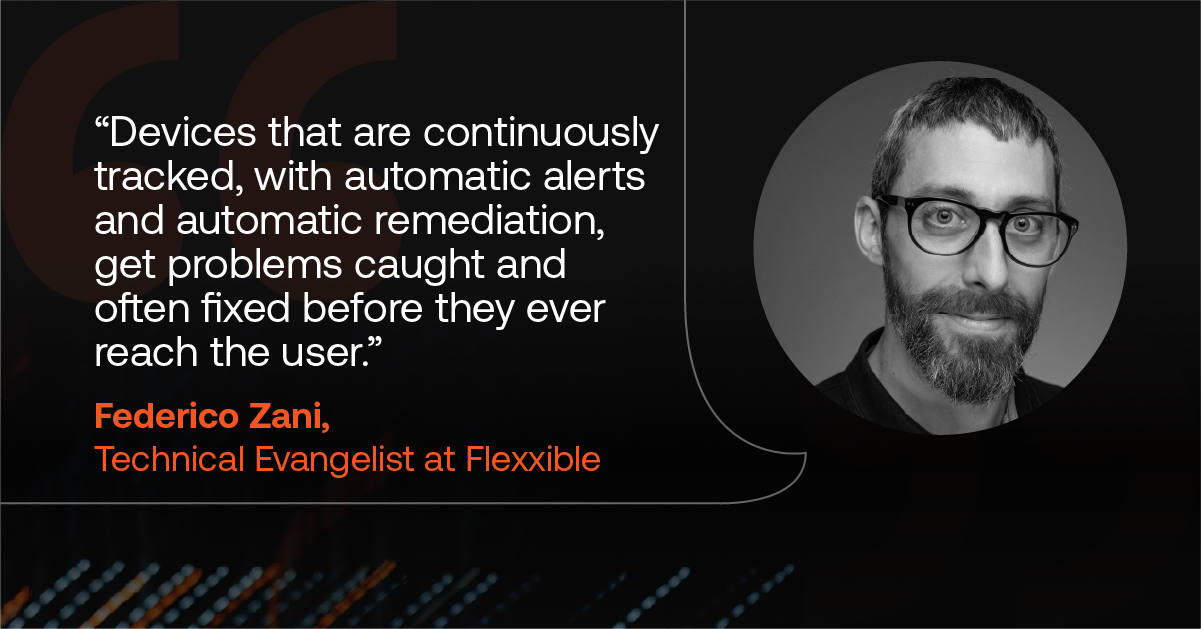
“Devices that are continuously tracked, with automatic alerts and automatic remediation, get problems caught and often fixed before they ever reach the user,” says Federico Zani, Technical Evangelist at Flexxible. “Devices that only get checked at compliance-audit intervals leave employees carrying the friction silently, often for months, until it becomes visible enough that someone finally investigates.”
3. Experience data
Pay attention to how the platform reports employee sentiment, DEX scores and application behavior. These will tell you much more about how using the device felt than just telemetry.
4. Integrations
If the platform comes with ITSM, identity, and security tooling then check whether those connections are turnkey or something your team builds against an API. This makes a big difference to the implementation timeline and decides how much of the integration you end up maintaining.
5. Commercial model
Modular platforms let you buy a single capability, expand into bundles, and scale as the estate grows. All-or-nothing licensing does the opposite and forces you to commit upfront.
Key things to check here are whether you’re charged per user or per device, and which services are included in the licence rather than arriving as add-ons, training, customer success and premium support are common exclusions.
6. Compliance and data residency
You should know where the platform stores telemetry and which certifications it holds. For regulated sectors and public-sector procurement in Spain, ENS Alto is a threshold requirement.
What does an endpoint management platform cost?
Many endpoint management platforms charge per endpoint or per user annually, and many only offer a competitive rate once you commit to a multi-year agreement.
This creates a problem: endpoint counts are unpredictable, so organizations sometimes get locked into an expensive long-term deal that their network will never fill.
Some vendors offer a remedy to this with a modular approach where they offer their customers the chance to start small and add to their package as the estate grows. This is how Flexxible works: you’re not committed to the full platform after sign-up, instead you can buy individual modules, bundles or the full platform on monthly, annual or multi-year terms, with discounts on volume and length.
Endpoint management in Spain: Where Flexxible has the advantage
As an IT leader, you may already run a UEM platform that ticks every line on an international feature list, but it won't get you through Spanish procurement.
This is where ENS Alto certification shows its value. As the first gate for public sector and regulated buyers, it's the one must-have that no amount of product capability can get you through.
Like most DEX platforms for enterprises, Flexxible hosts in Azure, so data stays in-region. Unlike most, it's developed in Spain, so escalation stays in Spanish all the way through, instead of routing you into English after the first line.
A recent report on digital employee experience by Gartner places Flexxible as a Niche Player, with DEX coverage spanning virtual environments rather than applications or unified communications.
Feature lists are written in English for buyers who don't have to satisfy a Spanish procurement panel. Flexxible was built by people who do.
FlexxClient brings endpoint management, patch management, and regulatory compliance into one console, then automates the fixes your team currently carries out by hand. Book a demo to see what it surfaces across your own endpoints.
Recommended for you
- AI-powered remote assistance, already built into your platform
- The Better Your Automation Gets, the Better Your Remote Assistance Has to Be: How to Modernize for 2026
- VDI vs DaaS: Which Do Large Enterprises Truly Need?
- Dynamic Workspace Groups: The Feature Almost Nobody Uses to Its Full Potential
- How To Find The Best Alternative to an Employee Experience Platform For Your Business in 2026
- Stop Counting Tickets: How to Measure Digital Employee Experience the Right Way
- Looking for a Nexthink Alternative? How to Find One That Works For Your Organization
- How to Make Wake on LAN Work For Your Business in 2026

