

The European digital workplace platform for better employee experiences, smarter IT operations, and work without friction.


Solutions
Autonomous IT is fast becoming the next big promise in enterprise tech, and it’s easy to see why.
Hybrid workforces are growing, and IT teams must manage thousands of endpoints across offices, homes, and virtual desktops. Support tickets also rise, and simply adding headcount isn’t realistic during an IT skills crisis where 63% of organizations already say their service desk is understaffed.
Many companies are turning to chatbots that log tickets and scripts that reboot machines and calling it “autonomous IT”, but this doesn’t cover the full scope of this technology. It’s more like remote monitoring and management (RMM) with a chat window.
Autonomous IT now goes far beyond what traditional automation can do, including AI agents that diagnose and fix problems on the device often before employees even notice them.
This guide looks at five providers that deliver this automated IT support and how it differs from RMM, so you can judge each one on how far its automation really goes.
We’ll cover:
FlexxClient and FlexxSolve give your employees technology experiences that safely enable business continuity and deliver measurable results to your business. Book a demo to see them in action.
Autonomous IT support uses AI-powered IT automation to diagnose and resolve technology issues with little to no human involvement. It works within rules the IT team sets.
The term is a broad church, however, and we can split autonomous IT into three general levels.
The most advanced tools can now see and operate on the screen in the same way a technician would. This moves us a large step closer to truly autonomous IT operations.
Remote monitoring and management (RMM) tools have been a staple of IT operations for years because many give IT teams a single view of the devices they manage.
Solid RMM will tell you when a device is online, whether it’s patched, and raise an alert when something breaks. A technician can then step in and resolve the issue.
Autonomous IT cuts out that last step and reports back once the problem is fixed, or hands a diagnosis to a technician when it can’t act. The best tools look beyond the device’s health and grade the digital employee experience (DEX) the user feels. This DEX score will dip if there are slow logins, app crashes, or faulty VPNs.
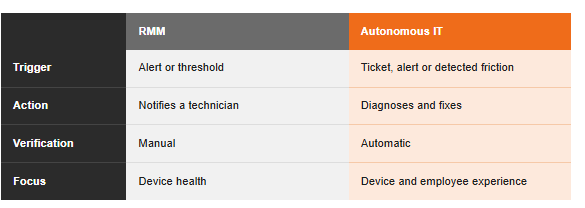
Autonomous IT does not need to replace RMM (the two can work side-by-side), but large, hybrid organizations now need more than monitoring alone.
Automated IT attacks helpdesk ticket volume in two ways.
First, it uses telemetry and anomaly detection to stop the ticket from appearing in the first place. Autonomous tools monitor device and application data around the clock, then spot when a driver fails or memory leaks before the employee does. They fix the issue in the background, and operations continue as normal.
Second, built-in incident management resolves the issues that do reach the helpdesk, especially repetitive Tier 1 requests, such as resets, reconnections, and cache clears. This lowers the mean time to resolution (MTTR) and frees analysts for complex work.
Gartner’s latest research puts this increased operational efficiency into numbers. By 2028, it predicts that digital workplace teams that fully operationalize a DEX platform will experience 50% lower incident- and experience-driven backlog than those that don’t.
Most vendors will claim some form of intelligent automation as part of their service, but much of this is simply rebranded traditional automation.
As an IT leader or CIO, you can ask yourself these questions to separate these from truly autonomous IT providers.
The next section looks at how today’s leading autonomous IT providers measure up against those questions.
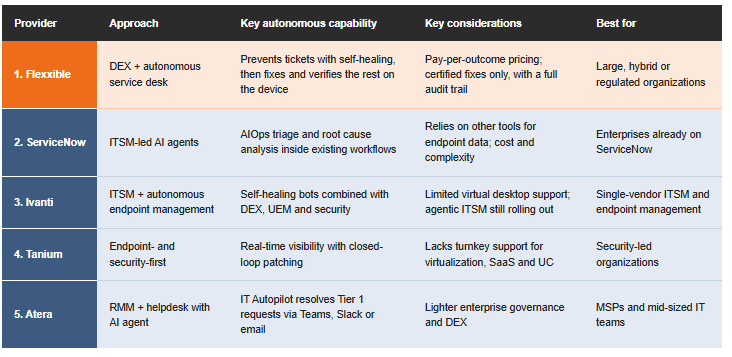
Flexxible covers both sides of the ticket with its two autonomous solutions.
FlexxSolve is a new autonomous service desk that takes requests from your ITSM or corporate chatbot, or other connected tools, including ServiceNow, BMC, Jira Service Management, and GLPI. Connecting a ticketing tool is optional. It puts each incoming ticket through four steps:
Operating as agentic AI, it doesn’t need to improvise because it only selects from Flexxible’s deep catalog of certified fixes. Flexxible’s engineers certify how each fix works, and your own IT team decides where FlexxSolve can use them: which categories it can touch, which actions need approval, and its monthly budget.
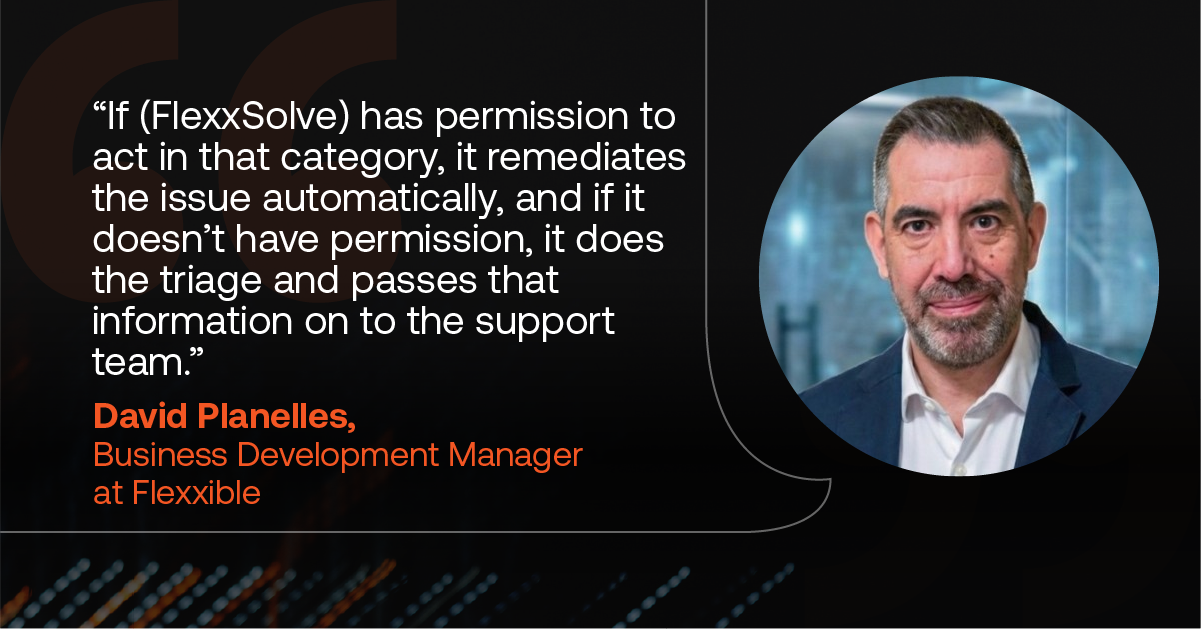
“When a ticket comes in, FlexxSolve automatically categorizes it,” says David Planelles, Business Development Manager at Flexxible. “If it has permission to act in that category, it remediates the issue automatically, and if it doesn’t have permission, it does the triage and passes that information on to the support team.”
When it does act, FlexxSolve works at two levels:
According to our own research, eligible tickets are resolved in less than seven minutes on average, across 125 resolvable categories, and its remediation engine already runs on more than 50,000 endpoints at public-sector scale. Pricing is based on outcomes instead of devices, so you only pay for each step a ticket reaches, instead of idle licenses.
FlexxClient, Flexxible’s DEX platform, covers the other side of the ticket. Its self-healing IT automates patching and fixes problems across physical and virtual desktops before a ticket appears.
Both solutions are built for European compliance. Data stays in-region, which supports GDPR and NIS2 obligations, and Flexxible holds ENS Alta certification, the highest level of Spain’s National Security Framework, required across the Spanish public sector.
Best for: Large, hybrid or regulated organizations that want verified fixes with tight governance.
If you’ve already got ServiceNow’s IT service management platform, then you can introduce AI agents into your existing workflows through the ServiceNow AI Platform.
These agents can handle repetitive ITSM tasks, and its AIOps capabilities help to triage alerts and carry out root cause analysis across the platform’s own and third-party data.
In January 2026, Ivanti announced agentic AI for Neurons ITSM, with general availability planned for later in the year. In April, it introduced a Neurons AI self-service agent on a controlled basis.
Gartner also notes that Ivanti’s offering leans toward lower-maturity IT operations use cases. It also pointed out that support for virtual desktops is limited to agents installed on them.
Tanium offers closed-loop remediation, which links vulnerability detection directly to patching, and offers an AI agent for ServiceNow.
According to Gartner, Tanium’s messaging now centers on Autonomous IT, including proactive detection, autonomous remediation, and human-in-the-loop governance.
Its DEX offering has less turnkey support for virtualization environments, web and SaaS applications, and UC tools.
Atera combines RMM, helpdesk, and ticketing in one platform. It now leads with Robin, an autonomous IT agent that Atera says handles Tier 1 and complex Tier 2 incidents without a technician.
That said, it is mainly built for the MSP market, with light enterprise governance and DEX.
Autonomous IT has grown to the point where it’s part of an organization’s operating model rather than just another tool.
Flexxible covers the full journey. FlexxClient spots and self-heals issues before they become tickets. FlexxSolve fixes the ones that do, verifies every result, and stays within the limits your team sets.
Both work across physical and virtual desktops, with data kept in Europe, and they make a powerful team. “FlexxSolve is combinable with FlexxClient, says David Planelles. “It’s possible to buy them separately, but they work seamlessly together as well.”

With every fix verified, your IT team can finally spend its time on the work that moves the business forward.
Start with a no-cost trial and see what FlexxSolve can resolve in your environment. Try it today.


Book a personalized demo or tell us what’s getting in the way.
We'll find the solution together.